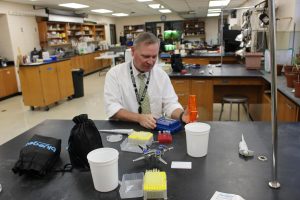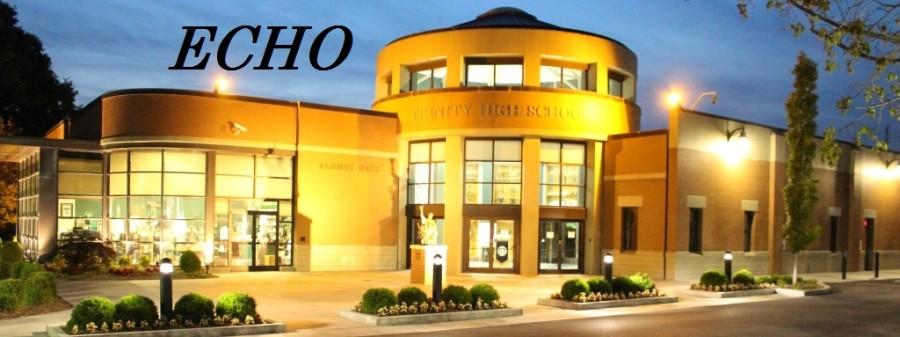

Mr. Heintz is not just an ordinary science teacher. He is someone who has lived a life of service, leadership and dedication to shaping the future. Before coming to Trinity High School, he served as an officer in the U.S. Army, training soldiers during Operations Iraqi Freedom and Enduring Freedom. He also created a sophisticated training system that was later adopted by the Army. His military experience taught him discipline, resilience and leadership — qualities he now brings into his classroom every day. At Trinity, he combines his passion for biology with hands-on STEM projects, helping students connect real-world applications to classroom learning.
Before teaching at Trinity, Mr. Heintz knew from a young age that he wanted to serve others. Whether through police work, firefighting or the military, he wanted to do something bigger than himself. He began his college career at the University of Louisville, but after being approached by an ROTC recruiter, his life took a different path. After signing his contract, he became an Army officer and chose to serve as an 88A transportation officer so he could remain closer to home, his wife and their soon-to-be son.
Although he was not the highest-ranking officer, Mr. Heintz frequently took on leadership roles that required him to guide and manage situations beyond his rank. His performance in training was so strong that the Army later adopted a training model he developed. His work earned recognition from a general, who awarded him a challenge coin for his detailed and well-executed presentation.
Throughout his military career, Mr. Heintz led by example, building strong relationships with the soldiers he trained. He demonstrated that true leadership involves guiding others while earning their trust and respect. These lessons in mentorship and discipline continue to shape his teaching philosophy.
Mr. Heintz’s path to becoming a science teacher began with his own inspiration as a student. In high school, his biology teacher, Coach Rourke, sparked his interest in science and showed him the lasting influence a great teacher can have. Initially, Mr. Heintz planned to study chemical engineering in college, believing it would provide a challenging scientific career. However, he realized he wanted to work directly with people rather than solely in a lab setting, which led him to switch his major to biology and ultimately pursue teaching.
His strong science background allows him to design engaging and rigorous lessons that challenge students to think critically and remain curious. He encourages students to see how science applies to everyday life and hopes to inspire them the same way his own teacher once inspired him.
At Trinity, Mr. Heintz has made a lasting impact on the school community. He has helped push forward initiatives such as the butterfly house, greenhouse and the state-of-the-art college preparatory STEM center. He believes learning should extend beyond textbooks and lectures, emphasizing hands-on activities that challenge students to solve real-world problems. He has also been a strong advocate for expanding STEM opportunities.
His work has earned him honors such as STEM Teacher of the Year and an Amgen Fellowship, where he collaborates with educators from around the world to improve science education. Beyond awards, Mr. Heintz prioritizes relationships with his students. He stays after school, arrives early and is always willing to help those who need it. He has said that Trinity is where he plans to finish his teaching career and hopes to be remembered as someone who made science meaningful and exciting.
Mr. Heintz’s journey — from a high school student inspired by his teacher, to a military officer developing training systems for the Army, to a father and mentor guiding more than 150 students — reflects his commitment to service and leadership. The discipline he gained in the Army and the mentorship he provides in the classroom demonstrate what dedication can accomplish. At Trinity, he has not only taught biology but also encouraged students to be curious, work hard and recognize how science connects to the world around them. His legacy will live on not only through the facilities he helped create, but through the students he has inspired.